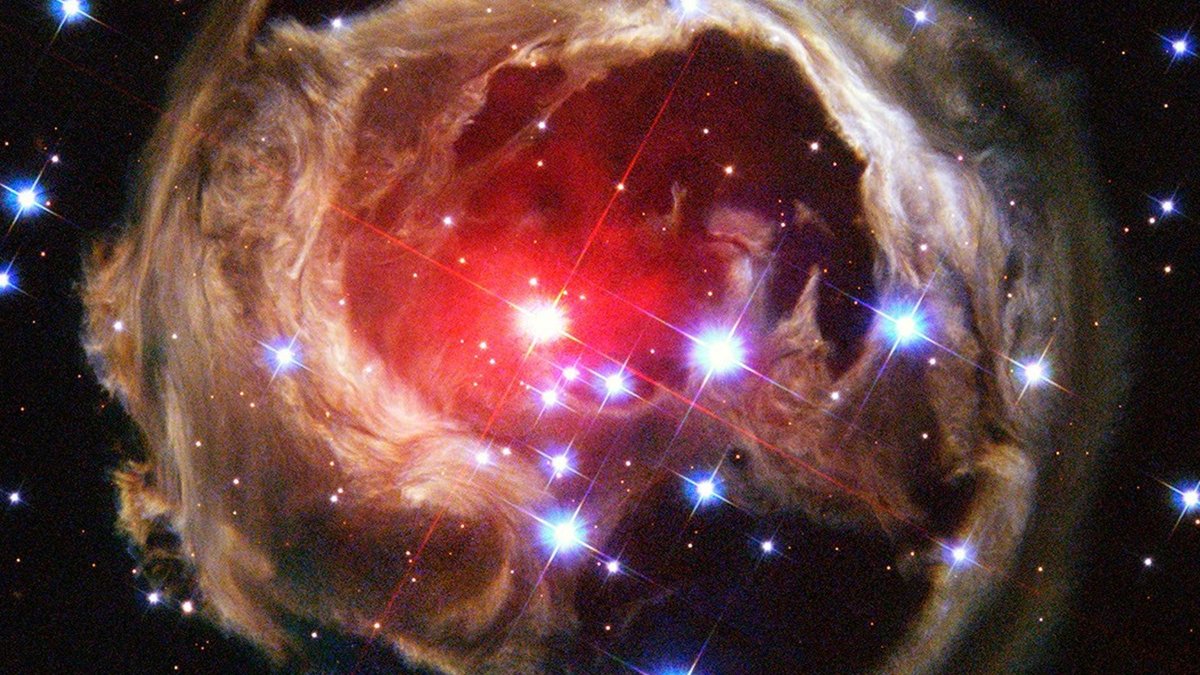
A nova explosion doesn’t just briefly shine and then disappear, as it also expels a shell of superheated gas at thousands of kilometers per second, which can cool and condense into cosmic dust within weeks.
Scientists have faced difficulties pinpointing exactly when cosmic dust begins forming after a nova explosion, as this initial stage remains undetectable through conventional optical telescopes.
For the first time, researchers using an automated infrared camera at Kitt Peak successfully tracked the start of dust production in the classical nova V488 Sge, providing fresh insights into an enduring mystery in astrophysics.
A Nova Erupts in Sagittarius
V488 Sge erupted on August 25, 2026. The NMW-TexasTech survey flagged the object in Sagittarius as a new transient.
The nova brightened to a peak visual magnitude of approximately 7.0, placing it near the limit of naked-eye visibility under dark skies.
Spectroscopic follow-up classified it as a classical Fe II nova with an ejecta expansion velocity of roughly 1,400 kilometers per second.
The nova’s t2 decline rate was about four days—a two-magnitude drop in that time—making V488 Sge one of the fastest-declining novae ever recorded.
MIRAGE: Infrared Without the Cryogenic Overhead
The breakthrough came from the MDM-Infrared InGaAs Experiment, MIRAGE, mounted on the 1.3-meter McGraw-Hill telescope at MDM Observatory on Kitt Peak, Arizona.
MIRAGE stands out due to its detector technology. Most near-infrared cameras in professional astronomy rely on arrays cooled by liquid nitrogen or complex cryogenic systems. These detectors generate thermal noise that obscures astronomical signals unless chilled to around 77 Kelvin or below.
Unlike traditional infrared cameras that require extreme cooling, MIRAGE uses indium gallium arsenide (InGaAs) detectors, similar to those used in fiber-optic networks, which function effectively at room temperature or with minimal cooling, covering wavelengths near 1.25 and 1.6 microns.
Read Also: Reddit to require user login for access
MIRAGE’s robotic operation adds another advantage. It can autonomously observe target lists, enabling long-term monitoring campaigns key for capturing the sudden onset of nova dust formation, which can progress within days.
The J-Hs Color Index as a Dust Diagnostic
The study by De et al., published on October 29, 2026, examined seven observations of V488 Sge in the J-band between October 20 and 27, 2026, around eight weeks after the nova’s initial outburst.
The key measurement is the color index: the difference between the J-band and Hs-band magnitudes, denoted as J-Hs.
In nova ejecta without dust, the near-infrared color is primarily driven by free-free emission and hydrogen recombination lines, keeping the J-Hs index near zero, indicating similar brightness in both bands.
When warm dust forms in the ejecta, it emits thermally across the near-infrared with a spectral energy distribution that rises sharply from J to Hs and beyond. The J-Hs index shifts to increasingly positive values as dust grain emission adds thermal flux to the measurement.
Between October 20 and 27, 2026, MIRAGE recorded the J-Hs color of V488 Sge reddening from approximately zero to roughly 0.7 magnitudes.
This shift of 0.7 magnitudes in the color index, measured over seven nights, is the infrared signature of warm dust condensing in the nova ejecta.
Importantly, the MIRAGE dust detection report notes that no corresponding optical dust dip, the dimming in visible light that occurs when dust absorbs the nova’s optical output, was observed during this period.
Dust Dip novae show pronounced dimming in optical light as dust absorbs the nova’s photospheric emission and re-radiates it in the infrared. This dimming can be dramatic, several magnitudes in the optical, and is detectable with ordinary visible-light photometry.
IR Excess novae, in contrast, show dust formation primarily through the thermal infrared emission of warm grains, without a corresponding optical dimming sufficient to flag the phenomenon in visible-light surveys.
Read Also: New York bans risky AI interactions for minors
V488 Sge falls into the IR Excess category: the dust is real, and MIRAGE detected it, but optical photometry alone would not have identified the event.
The dust condensation mechanism in novae remains a theoretical challenge. Novae eject material at supersonic velocities into an environment bathed in intense ultraviolet and X-ray radiation from the central hot white dwarf.
Under these conditions, standard dust condensation physics, which requires relatively cool, dense environments to nucleate solid grains, should not operate efficiently. Yet nova dust forms rapidly and abundantly, sometimes within days of the initial outburst.
Studies of nova dust condensation identify the grain types produced, silicate and carbonaceous grains at different temperature regimes, and the timescales over which condensation occurs.
Real-time observations of the onset phase, such as those obtained by MIRAGE for V488 Sge, provide direct constraints on when condensation begins and how quickly the J-Hs color index evolves.
The classical nova thermonuclear mechanism, hydrogen fusion on the surface of a white dwarf accumulating mass from a binary companion, has been understood in broad terms for decades.
What has remained elusive is the dust that follows: when it forms, how fast it grows, and why it survives the nova radiation long enough to escape into the interstellar medium.
MIRAGE’s seven nights of photometry on V488 Sge do not resolve these questions, but they mark the moment the clock started ticking on this nova’s dust, a measurement that no optical survey could have made.
MIRAGE’s Detector Technology and Observational Advantages
The use of InGaAs arrays has become economically viable due to demand from the telecommunications industry, mirroring how CCD detectors transformed optical astronomy in the 1980s and 1990s. While MIRAGE’s sensitivity does not match that of larger cryogenic instruments or space-based platforms like JWST, its design allows for continuous monitoring of bright transients. This capability is particularly valuable for tracking phenomena like dust formation in novae, which evolve over weeks or months and require frequent observations.
In the case of V488 Sge, MIRAGE’s robotic operation enabled nightly observations, capturing the onset of dust condensation. By measuring the nova’s brightness in the J and Hs bands across seven epochs from October 20 to 27, 2026, the instrument detected a 0.7-magnitude shift in the J-Hs color index. This change confirmed the presence of warm dust, demonstrating that a modest 1.3-meter telescope with room-temperature infrared technology can effectively study transient astrophysical events.


