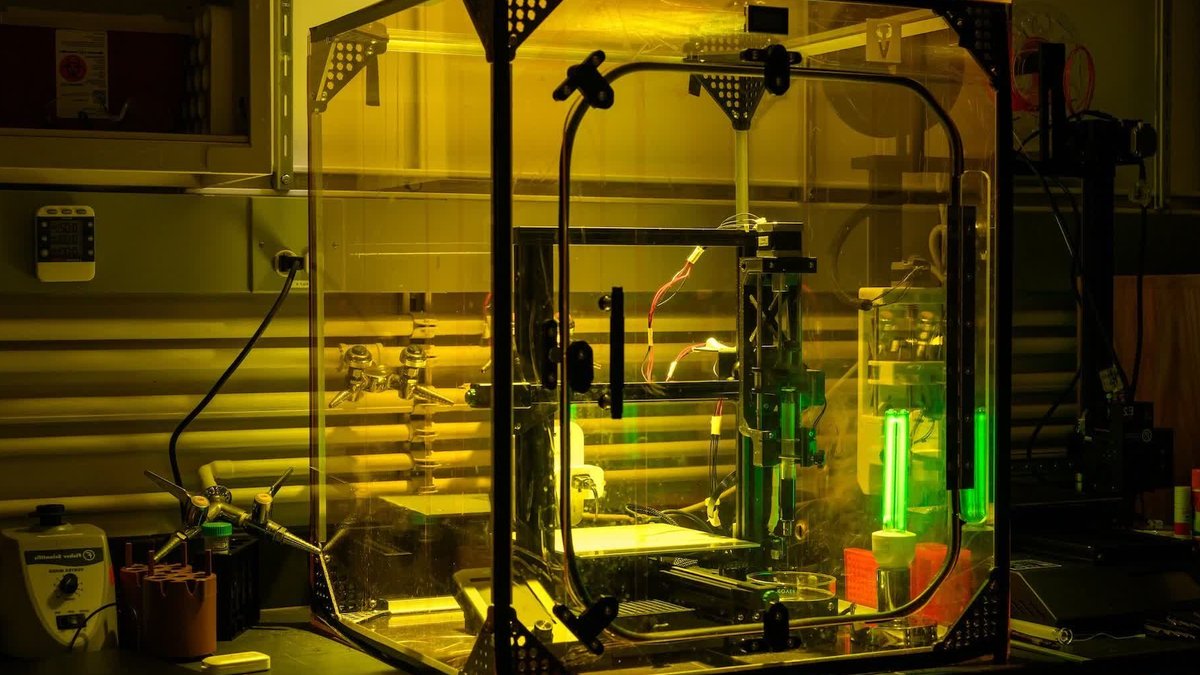
A team of researchers from the University of Rochester and Cornell University has successfully modified a standard 3D printer to build 100-layer structures using living bacteria. They started with a Creality Ender 3 and replaced its print head with a syringe pump held together by 3D-printed PETG components.
The pump can push and pull ink, reducing stray bacterial deposits by nearly 100-fold. This allows the setup to print “crisp shapes with well-defined edges,” according to lead researcher Anne Meyer.
The team’s technique involves printing inside a slurry made of tiny gelatin or agarose particles mixed with calcium chloride. The bath supports each layer as it is printed, while the calcium quickly sets the alginate-based ink. This method enables the creation of complex structures.
Read Also: Microsoft expands AI tools for large companies
The technique is similar to the FRESH method used by Carnegie Mellon to print human liver tissue. The team’s preprint shows a 100-layer structure measuring just under 22 mm tall, roughly the width of a US nickel.
The ability to print hollow cylinders and lattice structures exposes more surface area to the bacteria inside, allowing them to absorb nutrients and release metabolic byproducts more efficiently. Meyer’s lab has been developing its own bioprinters for over a decade to create living test structures for research into antibacterial applications and wastewater treatment.
The team has posted the STL files and G-code on GitHub, making it possible for many labs and hobbyists to replicate the system using a standard Ender 3. The cost of this setup is around $450, a significant reduction compared to commercial models which can cost over $100,000.


