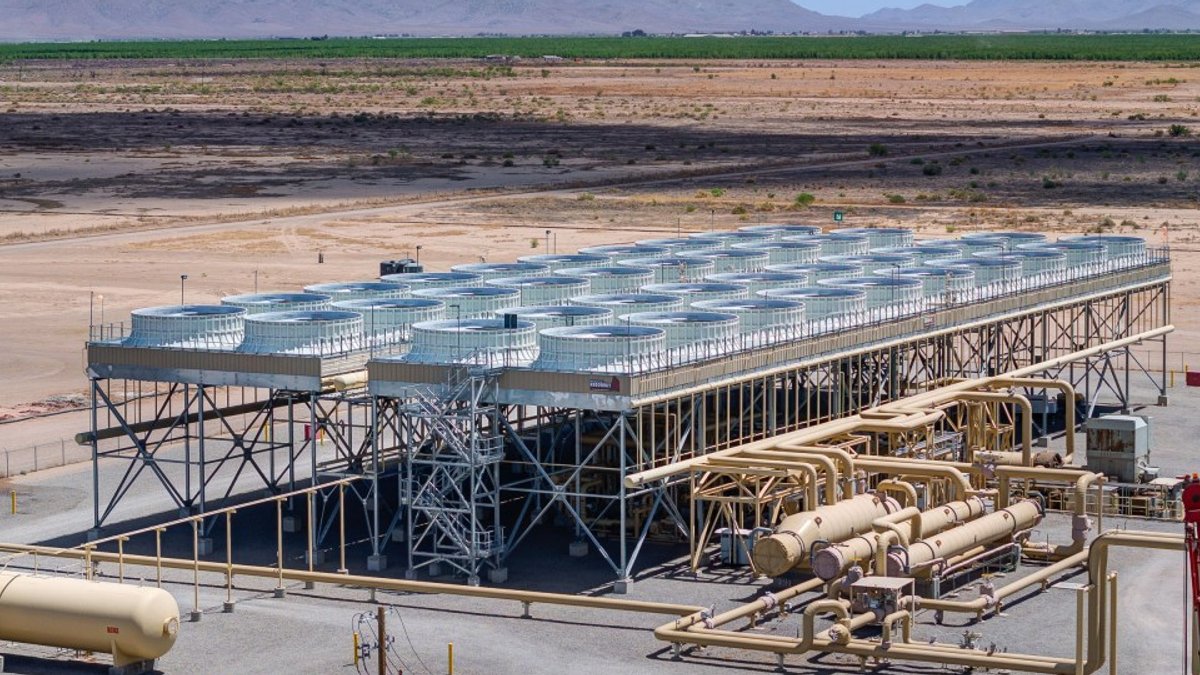
In June 2024, a small company called Zanskar purchased a geothermal power plant in New Mexico that was failing fast.
The water coming from the underground reservoir was getting colder by the day, making the plant uneconomical to run.
Now, two years later, that plant is running at full capacity again, thanks to a new well.
With the help of advanced modeling and modern drilling technology, the company was able to identify a better potential well site, drill down thousands of feet, and revive the entire operation.
Reviving a Failing Plant
Conventional geothermal power plants rely on having the right underground conditions.
Water flows through fractured hot rocks to harvest heat and then through a power plant to generate electricity.
Lightning Dock came online in 2013, and the site historically had two production wells that were used to feed the power plant.
It’s common to see temperatures drop at a well site over time, typically at a rate of 1 to 2 °F per year.
In the period before Zanskar took over the site, Lightning Dock saw temperatures drop by 50 °F over five years, a rate of 10 °F per year.
When the company purchased the facility, the water going into the power plant was just 250 °F, while the plant was designed to operate at temperatures of at least 310 °F.
A New Approach
Zanskar mapped the underground conditions at Lightning Dock using advanced modeling techniques.
They discovered that the wells were only hitting the very top of the reservoir there.
Those production wells were quite shallow, at just 2,500 feet deep, and not in the best location, says Joel Edwards, Zanskar’s cofounder and CTO.
The company’s modeling predicted that if they were to drill another, deeper well in a new spot, the plant would be able to run efficiently.
Zanskar drilled a new well that reaches a depth of 8,000 feet and started operation in May 2025.
After a full year, the well is still flowing at more than 4,000 gallons per minute.
The plant has “completely turned around,” Edwards says.
“It looks really exciting.”
The data so far shows that the plant should be successful for years to come.
“Ultimately you need to run these things for long time frames to get confidence in their performance over long time frames,” Edwards says.
Related: Bose ANC earbuds discounted by $50
The progress at Lightning Dock could be good news for other geothermal sites too.
The conventional wisdom in geothermal energy is that the deeper you go, the hotter it gets.
But there’s usually a trade-off: With those depths come rocks that are packed tighter together.
So drilling deeper could mean the hot water can’t flow as effectively, a problem for anyone trying to use it to generate electricity in a power plant.
What they found, however, was that the flow actually increased in the area where they drilled the new well.
“That fundamentally changes how you think about not just Lightning Dock but all hydrothermal assets in America and what the potential can be for all of them,” says Ben Brenner, director of federal affairs at Zanskar.
A Broader Impact
Over the past year of operation, Lightning Dock generated over twice the electricity it would have with the old wells.
This is a relatively small power plant, with a capacity of 15 megawatts going to the local grid.
Oil and gas developers have chased resources deeper underground over the past few decades.
Operations started relatively close to the surface, but oil and gas production can stretch down 20,000 feet or more today.
“I think that arc is going to play out in geothermal,” Edwards says.
While typical geothermal well fields range from 3,000 to 5,000 feet deep, it could become more common to go deeper in the future, he adds.
The company plans to do further development at the Lightning Dock site: with a few years of development and an upgrade to the power plant, it could get even more electricity out of this area, Edwards says.
As the world looks for more sources of emissions-free electricity that are available 24-7, Lightning Dock shows there’s still hidden potential deep beneath our feet.
Many of these conventional resources have plenty of potential—they just need a second look.
Given the current focus on nuclear fuel production, the success of Lightning Dock is a reminder that existing infrastructure can be revitalized with the right approach.
The fact that Zanskar was able to increase the flow of hot water by drilling deeper challenges the conventional wisdom in the field and opens up new possibilities for energy production.
The company’s approach to geothermal energy production is not alone in its innovation, as other companies, like Fervo Energy, are also working on enhanced geothermal systems.
The story of Lightning Dock highlights the potential for growth in the geothermal sector by re-examining and improving existing sites.


