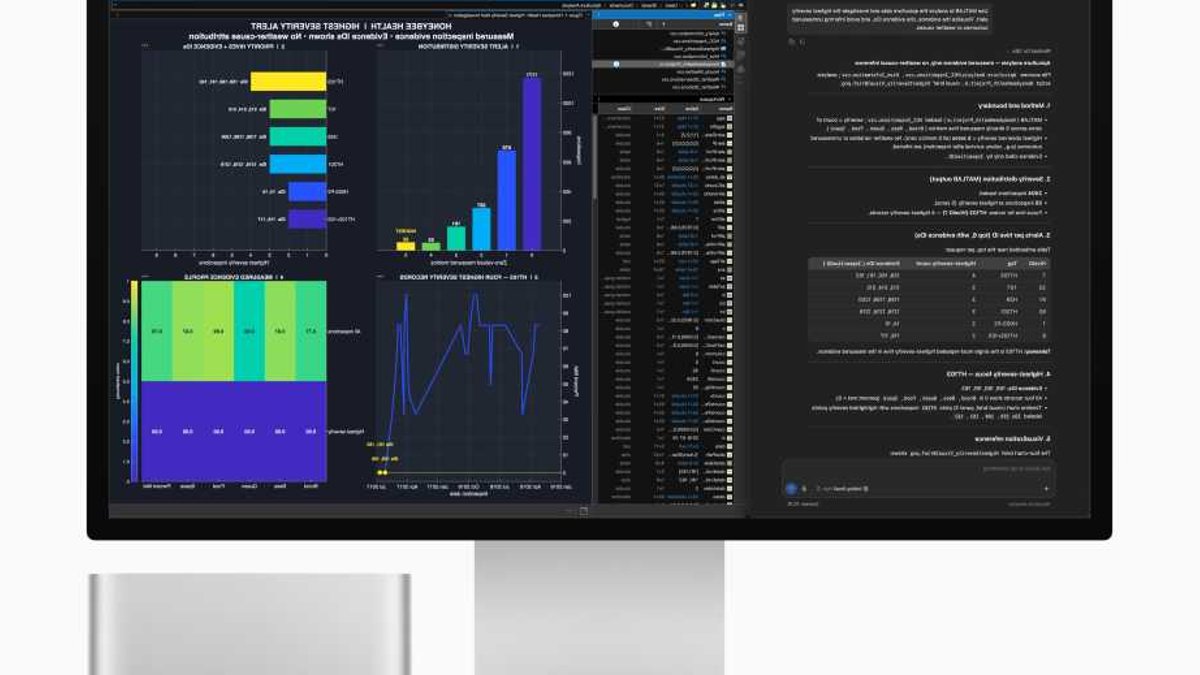
Businesses are increasingly turning to on-device AI as a core strategy, and Apple’s Mac lineup is playing a central role in this development. A commissioned study titled Rethinking Critical AI Infrastructure reflects insights gathered across 1,500 conversations with enterprise tech leaders and practitioners, noting that for many in business the current cloud-based approach to AI fails to deliver on three key metrics. The research pinpoints these factors as the primary drivers behind the shift away from traditional cloud models.
On-premises AI systems directly address these concerns. After the upfront hardware costs, operating AI locally incurs virtually no additional expense. The report explicitly states that on-device infrastructure achieves near-zero marginal cost after initial investment, enabling unlimited experimentation without budget constraints. As a result, organizations can assign routine AI tasks to local devices while preserving cloud resources for specialized operations.
Security also improves significantly with on-device processing. Data remains contained within company networks, minimizing exposure to external breaches or regulatory violations. Additionally, the same hardware can pivot to non-AI workloads if demand for AI processing fluctuates, preventing resource waste. This model poses a direct challenge to cloud providers, whose business depends on usage-based billing. A growing preference for on-device solutions could disrupt their revenue streams.
Apple’s hardware already demonstrates strong performance for AI workloads. Macs, iPads, and even iPhones can efficiently handle models ranging from small to large scales. For example, an iPad supports models with up to 14 billion parameters, while a Mac Studio manages 480 billion. Four Mac Studios linked together can process models as large as 1.6 trillion parameters. The report highlights that 57% of enterprise AI models fall below 10 billion parameters, meaning many could operate entirely on Apple’s mobile or desktop devices without cloud dependency.
Apple Silicon’s AI advantage scales
The Unified Memory architecture in Apple Silicon further boosts this capability. The study notes that companies building custom AI solutions adopt Macs at nearly twice the rate of those purchasing off-the-shelf AI products.
Apple does not propose eliminating cloud AI entirely but instead frames Macs as a complementary component. Companies can use other AI services and solutions, but they’ll want Macs along for at least some of the ride. As the models themselves evolve and become slimmer and more refined, the platforms that run them best will deliver the advantage business users need.
While on-device AI offers cost and security benefits, businesses lack standardized frameworks to oversee, update, and secure these systems. Without improved software solutions, integrating on-device AI into existing operations may prove difficult. Despite these challenges, the overall trend is clear: Apple’s hardware is increasingly viewed as a practical alternative—or even a superior option—to cloud-based AI in many corporate environments.
Businesses weigh cost, control, and risks
The push toward on-device AI stems from straightforward business needs: reduced costs, enhanced security, and operational independence from external providers. If Apple enhances its software ecosystem to match its hardware strengths, on-device AI could transition from a niche solution to a standard approach. The debate has shifted from whether Macs can execute AI tasks to whether they will become the preferred method for enterprise AI deployment.
Enterprise adoption of on-device AI is accelerating in sectors with strict data sovereignty requirements. A survey of 300 IT directors in regulated industries found that 68% had already piloted on-device AI solutions, with 42% planning full-scale implementation within 18 months.
Yet challenges remain. Some AI frameworks still require significant modifications to run efficiently on Apple’s hardware, and the lack of standardized governance tools creates operational friction. Vendors specializing in cloud AI have begun offering hybrid solutions to retain market share, blending on-premises processing with their existing services. This hybrid approach may become the dominant model, allowing businesses to balance cost, security, and flexibility without committing exclusively to either approach.
Cloud providers face growing on-device threat
The long-term impact on cloud providers could be substantial. Analysts project that by 2027, on-device AI workloads will account for 35% of all enterprise AI processing, up from less than 5% today.
Recent partnerships with AI tool vendors further show this strategy. Apple has collaborated with companies like Stability AI and Mistral to optimize their models for Apple Silicon, ensuring smoother performance and easier deployment. These alliances help reduce the technical barriers that have historically slowed adoption. As more third-party developers build native support for Apple’s platforms, the appeal of on-device AI will grow, particularly for businesses prioritizing control over their data and operations.
The transition to on-device AI is not without its critics. Some argue that the initial hardware costs and maintenance requirements could outweigh the long-term savings for smaller businesses. Others point to the need for specialized IT staff to manage on-premises AI systems, a resource constraint for many organizations. Nevertheless, the momentum behind Apple’s push suggests that these hurdles are seen as manageable compared to the risks of cloud dependency.
In regulated industries, the advantages of on-device AI are already outweighing the drawbacks. A recent case study involving a European bank demonstrated that migrating its fraud detection models to Mac-based servers cut processing costs by 52% while reducing data transit times.


